
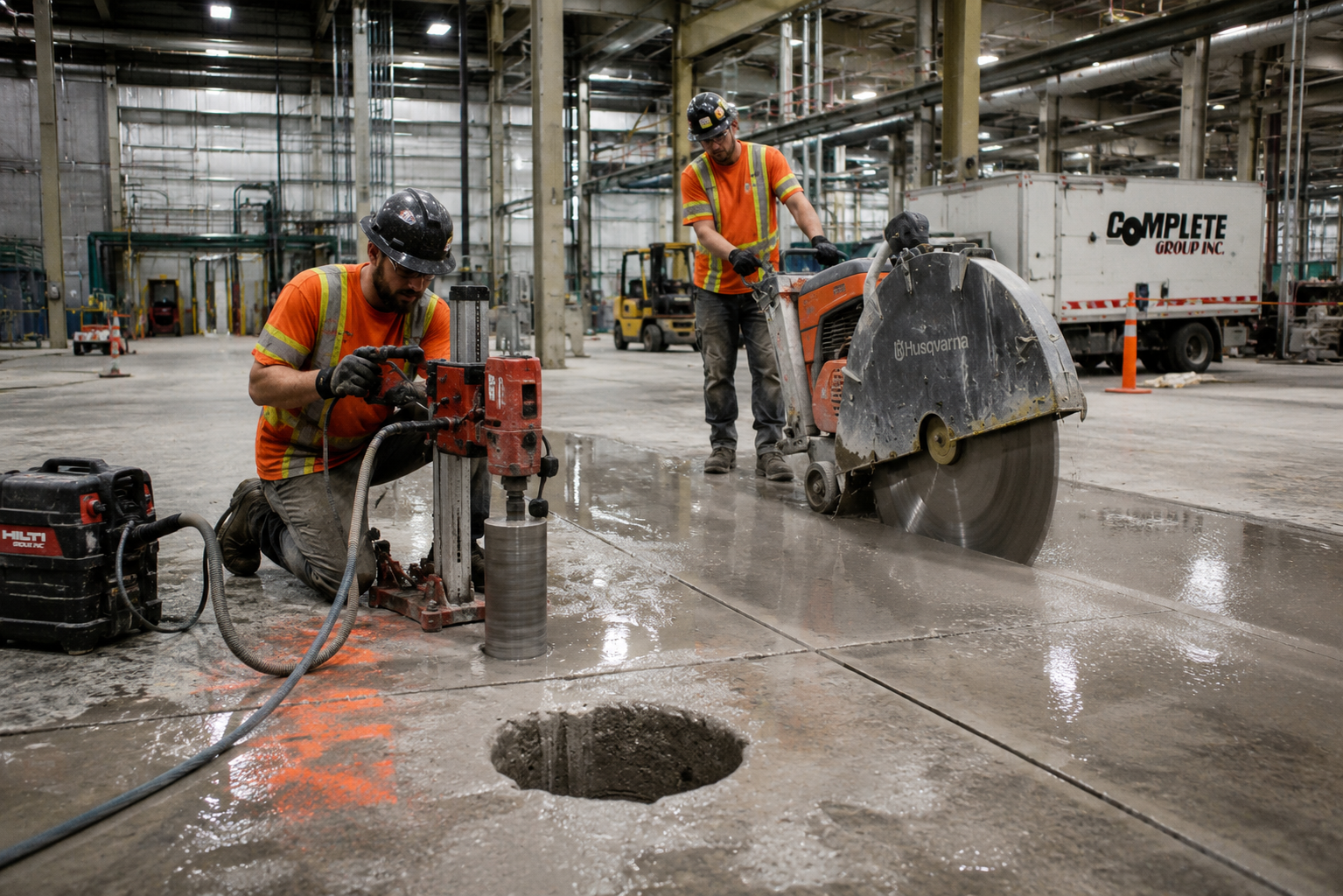
Commercial and industrial concrete cutting projects involve a wide range of structural conditions, access limitations, and coordination requirements. Different cutting methods are designed to solve different project challenges, and selecting the right approach can improve efficiency while reducing unnecessary disruption on active job sites.
For general contractors, mechanical contractors, facility managers, and industrial project teams, understanding the differences between core drilling, floor sawing, wall sawing, and wire sawing helps support better planning and smoother execution. Each method is suited for specific applications depending on the size of the opening, the orientation of the cut, the level of reinforcement, and the operational requirements of the facility.
What Is Core Drilling?
Core drilling is used to create clean, circular openings in concrete, masonry, and reinforced concrete structures. It is commonly selected for utility penetrations, plumbing lines, HVAC systems, refrigeration piping, and electrical service installations where precise access points are required.
Projects that require controlled openings for mechanical systems or service penetrations often rely on core drilling services because the process allows contractors to create accurate openings without unnecessary concrete removal. This makes core drilling especially useful in occupied commercial and industrial facilities where maintaining a clean and controlled work environment is important.
Core drilling is frequently used during tenant improvements, facility upgrades, equipment installations, and infrastructure modifications. Mechanical and plumbing contractors often coordinate drilling locations early in the planning process to ensure utilities can be routed efficiently through slabs, walls, and structural elements.
Another advantage of core drilling is its suitability for reinforced concrete applications. Diamond drilling equipment can cut through reinforced sections while maintaining precise hole sizing and alignment. This level of accuracy is important when utility penetrations must align with existing systems or support future trade installations.
A common misconception is that core drilling can replace other concrete cutting methods. In reality, core drilling is intended specifically for circular penetrations. It is not designed for trenching, slab separation, or large access openings where linear cutting methods are required.
Use core drilling when the project requires clean circular penetrations with minimal disruption and controlled concrete removal.
When Floor Sawing Is the Better Option
Floor sawing is typically the preferred method when projects require long, straight cuts through concrete slabs or flooring systems. This method is commonly used for slab access, utility installation, trenching preparation, and controlled concrete removal in commercial and industrial facilities.
Projects involving slab modifications or access pathways often benefit from floor sawing services because the process provides accurate linear cutting with controlled depth and clean separation. Floor sawing is commonly used in warehouses, manufacturing facilities, commercial buildings, and industrial plants where operational coordination is necessary.
For projects involving underground utility routing or mechanical system upgrades, concrete trenching and interior slab cutting are often required to prepare pathways for plumbing, drainage, electrical, or refrigeration systems. These applications demand precision and planning to avoid unnecessary slab removal while maintaining access for other trades.
Floor sawing is also effective for concrete removal planning, slab isolation, expansion joint modifications, and controlled demolition preparation. Contractors frequently use this method when large sections of flooring must be removed while preserving surrounding concrete surfaces.
Unlike core drilling, floor sawing is designed specifically for continuous linear cuts. Core drilling cannot efficiently replace slab cutting when projects involve trench runs, long access cuts, or slab separation work.
Use floor sawing when the project requires precise linear cutting through concrete slabs or flooring systems with controlled removal and efficient access preparation.
When Wall Sawing Makes Sense
Wall sawing is used for vertical and structural concrete cutting applications where clean openings and controlled removal are required. This method is commonly used for door openings, window openings, ventilation access, structural modifications, and mechanical penetrations in reinforced concrete walls.
Commercial renovations and industrial facility upgrades often require wall sawing services to create accurate vertical openings while minimizing unnecessary demolition. Wall sawing allows contractors to maintain cleaner edges and better cutting control during structural access work.
This method is especially valuable in active facilities where maintaining operational continuity is important. Precision wall cutting helps reduce disruption to surrounding areas while supporting coordinated installation work for other trades.
Wall sawing is commonly used in reinforced concrete structures where conventional cutting methods may not provide the accuracy or access required. It also supports projects involving elevator openings, stairwell modifications, doorway expansions, and equipment access points.
A common misunderstanding is that floor sawing or core drilling can achieve the same results for large vertical openings. In practice, wall sawing is specifically designed for vertical structural cutting and controlled removal in reinforced concrete wall systems.
Use wall sawing when the project requires precise vertical openings with clean edges and controlled structural access.
When Wire Sawing Is Required
Wire sawing is the specialized solution for projects involving thick reinforced concrete, oversized structures, or large-scale removals that exceed the capabilities of conventional saw cutting equipment.
Heavy industrial projects often rely on wire sawing services when structures contain significant reinforcement, unusual dimensions, or limited access conditions. Wire sawing is commonly used for equipment foundation removal, structural demolition preparation, bridge modifications, and large industrial concrete alterations.
Unlike standard saw cutting methods, wire sawing can handle deeper and more heavily reinforced concrete sections with greater flexibility. The process uses a diamond wire system capable of cutting through large concrete masses where traditional blades become impractical.
Industrial facilities often require wire sawing during expansion projects, structural retrofits, or equipment replacement work where large sections of reinforced concrete must be removed in a controlled manner. This approach allows contractors to complete heavy structural cutting while maintaining better control over surrounding infrastructure.
Standard saw cutting methods are not always practical for oversized or heavily reinforced structures. When project scale, concrete thickness, or reinforcement levels exceed conventional equipment capabilities, wire sawing becomes the more effective solution.
Use wire sawing when projects involve large structural removals, heavy reinforcement, or concrete depths beyond standard cutting methods.
Choosing the Right Method for Commercial & Industrial Projects
Selecting the correct cutting method depends on more than the equipment involved. Commercial and industrial projects often require coordination between multiple trades, operational scheduling, site access planning, and reinforced concrete considerations.
On larger projects, different cutting methods are frequently combined to support various stages of work. A project may involve core drilling for utility penetrations, floor sawing for trench access, wall sawing for mechanical openings, and wire sawing for structural removals within the same facility.
Occupied environments also influence the selection process. Contractors and facility managers often prioritize methods that support controlled cutting, cleaner work areas, and minimized disruption to ongoing operations.
Project planning should also account for utility routing requirements, structural conditions, removal sequencing, and access limitations before cutting begins. Early coordination with an experienced concrete cutting contractor can help reduce scheduling conflicts and improve project efficiency.
Working With an Experienced Concrete Cutting Contractor
Commercial and industrial concrete cutting projects require careful planning and coordination to ensure the correct cutting methods are used at the appropriate stages of construction or renovation.
Selecting the right approach early can help reduce delays, support trade coordination, and maintain cleaner working conditions throughout the project. Contractors working in active commercial and industrial environments must also consider operational impacts, access restrictions, and sequencing requirements before cutting begins.
Experience with reinforced concrete cutting, occupied facilities, and multi-trade coordination helps ensure projects move forward efficiently while maintaining controlled work conditions.
Request an Estimate
Call (519) 465-4107