
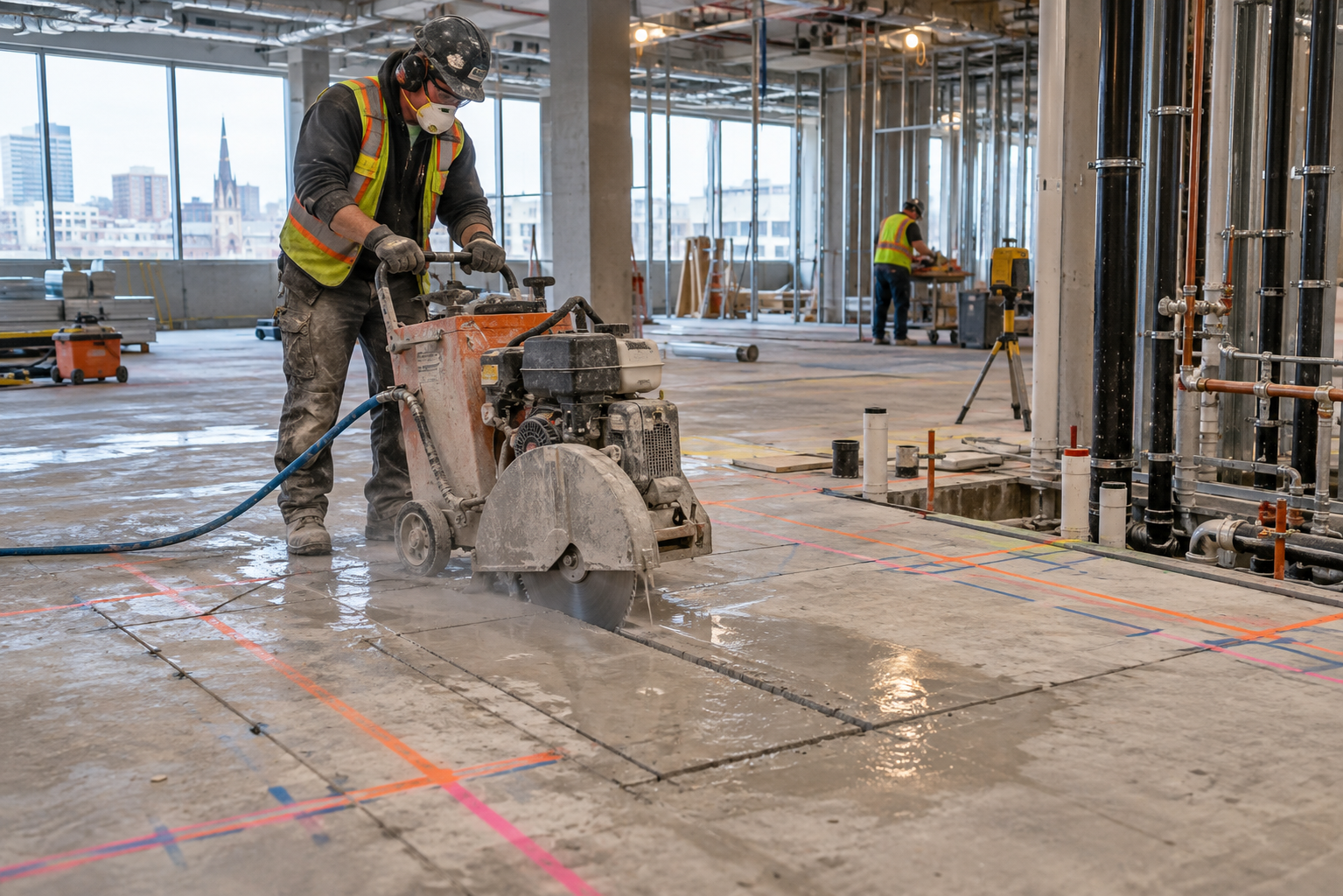
Commercial buildings are often renovated, reconfigured, or upgraded long after the original concrete floor was installed. New plumbing, mechanical systems, refrigeration equipment, electrical services, drainage, or equipment layouts can create a practical obstacle: the existing slab is now between the contractor and where the new service needs to go.
On a London commercial concrete cutting project, opening an existing slab can involve different concrete cutting methods depending on the required modification. The work may involve a defined opening, a continuous service route, excavation below the floor, or an individual penetration through the concrete.
The important question is not simply how to remove concrete. It is what type of access the project requires and how the concrete work fits into the broader construction sequence.
Why Commercial Contractors Need to Open Existing Concrete Floors
Existing slabs can become an obstacle when a commercial building needs new or relocated services. Plumbing and drainage changes may require access below the floor, while mechanical or refrigeration installations may need new routes through areas that were not designed for the current building layout.
The same issue can arise during electrical or communication work, equipment installations, tenant improvements, industrial modifications, and other changes to existing infrastructure. In each case, the concrete floor is part of a larger project problem rather than the final objective of the work.
That distinction matters when establishing the concrete cutting scope. A contractor may need one opening at a specific location, several individual penetrations, or a continuous path across part of the floor.
The required service route determines where the slab needs to be opened and what kind of opening the project needs.
Floor Sawing Creates Controlled Access Through the Existing Slab
When a commercial project requires controlled linear cuts through an existing horizontal slab, floor sawing can be used to establish defined cut lines based on the project layout.
Those cuts can outline a section of concrete that needs to be removed, create access for a planned modification, or prepare an area for additional work below the slab. The focus is on creating the required opening in a controlled location so the next phase of the project can proceed.
This makes planning the opening important before cutting begins. The trade requiring access should establish where the service needs to travel and what area needs to be opened so the concrete cutting scope reflects the actual project requirements.
Floor sawing is therefore part of the access solution. It creates the defined boundaries needed for planned modifications to the existing floor.
When the Project Requires a Continuous Utility Trench
Some commercial projects require more than an isolated opening. Plumbing, drainage, mechanical, refrigeration, or other services may need to follow a continuous route beneath or through a longer section of the existing floor.
In those situations, the project may progress from layout to slab cutting, followed by concrete removal and creation of the required trench or access route. The appropriate trade can then complete the planned installation according to the project requirements.
Concrete trenching and interior slab cutting can support this type of work when a continuous route is needed through an existing floor.
Floor sawing and trenching are not necessarily alternative services. On some projects, they are different stages of the same scope. The required route determines how the work fits together, and the actual sequence depends on the site conditions, plans, and contractors involved.
What Happens When the Project Also Requires Excavation Below the Slab?
Cutting and removing the concrete may only expose the next part of the work. If a service needs to be installed below the existing floor, material beneath the slab may also need to be excavated.
Indoor excavation introduces another coordination point. Commercial work areas can have restricted access, other active trades, existing building services, and operational constraints that influence how the project is organized.
Where excavation below the slab forms part of the indoor scope, electric excavation may be relevant to the project. Its role is separate from the slab cutting itself but can form part of the same overall access requirement.
The concrete cutting contractor and installing trades therefore need to understand how the opening, concrete removal, excavation, and installation work relate to one another.
Does the Project Need a Trench or Just a Concrete Penetration?
Not every building modification requires a continuous section of floor to be opened. Some services only need to pass through the concrete at a specific location.
For an individual penetration, core drilling may fit the requirement. A longer service route beneath or through the floor may instead require slab cutting and trenching.
Some commercial projects can involve both. A main service route may require a continuous opening, while connections or other building services elsewhere in the project may require individual penetrations.
The decision should follow the required opening rather than starting with a preferred cutting method. Project plans, site conditions, installing trades, and the appropriate project professionals determine what access is needed.
Coordinate the Concrete Work With the Trade That Needs the Opening
Concrete cutting is most effective when the scope is based on the actual requirements of the trade using the opening. That means confirming the planned service route, required opening locations, work-area access, and the relationship between the cutting work and the rest of the project.
Mechanical, plumbing, electrical, refrigeration, and other contractors may have different access requirements. Those requirements should be established before the slab is opened so the concrete work supports the intended installation.
Existing building services also need to be considered as part of the project planning process. Concrete removal, access to the work area, sequencing with other trades, and conditions in occupied or operational spaces can all affect how the work is coordinated.
The goal is not to treat concrete removal as an isolated task. The concrete cutting scope should support the modification that the project team is trying to complete.
One Commercial Project Can Require Several Concrete Cutting Services
A commercial building modification can involve several types of concrete work without every service being required on every project.
For example, a planned service route through an existing building may require controlled floor cuts to define an opening. If the route continues beneath a longer section of slab, trenching may form part of the scope. Excavation may then be required below the opened floor so the installing trade can complete its work.
Elsewhere on the same project, another service may only require an individual penetration through the concrete.
The point is not that every slab-opening project requires floor sawing, trenching, excavation, and core drilling. The combination depends on what opening the project requires and what work needs to happen after access is created.
Planning Concrete Slab Cutting on an Active London Commercial Project
Existing commercial buildings can present different conditions than new construction. Renovations, retrofits, industrial modifications, tenant improvements, and other multi-trade projects often require new work to be integrated with existing building infrastructure.
That makes coordination before cutting especially important. Contractors may need to consider access to the work area, other active trades, concrete removal, work sequencing, existing services, and whether the facility will remain occupied or operational during parts of the project.
Complete Cutting & Coring works within these broader scopes as a commercial and industrial concrete cutting contractor. The required opening can determine whether the work involves floor sawing alone or a combination of slab cutting, trenching, excavation, and core drilling.
Discuss the Slab Cutting Scope Before Work Begins
Before concrete cutting begins, provide the information needed to understand the planned opening and how it fits into the project. That can include the service route, opening locations, site conditions, access considerations, and related work being completed by other trades.
Establishing those requirements early helps define the concrete cutting scope around the actual building modification rather than treating slab removal as a separate task.