
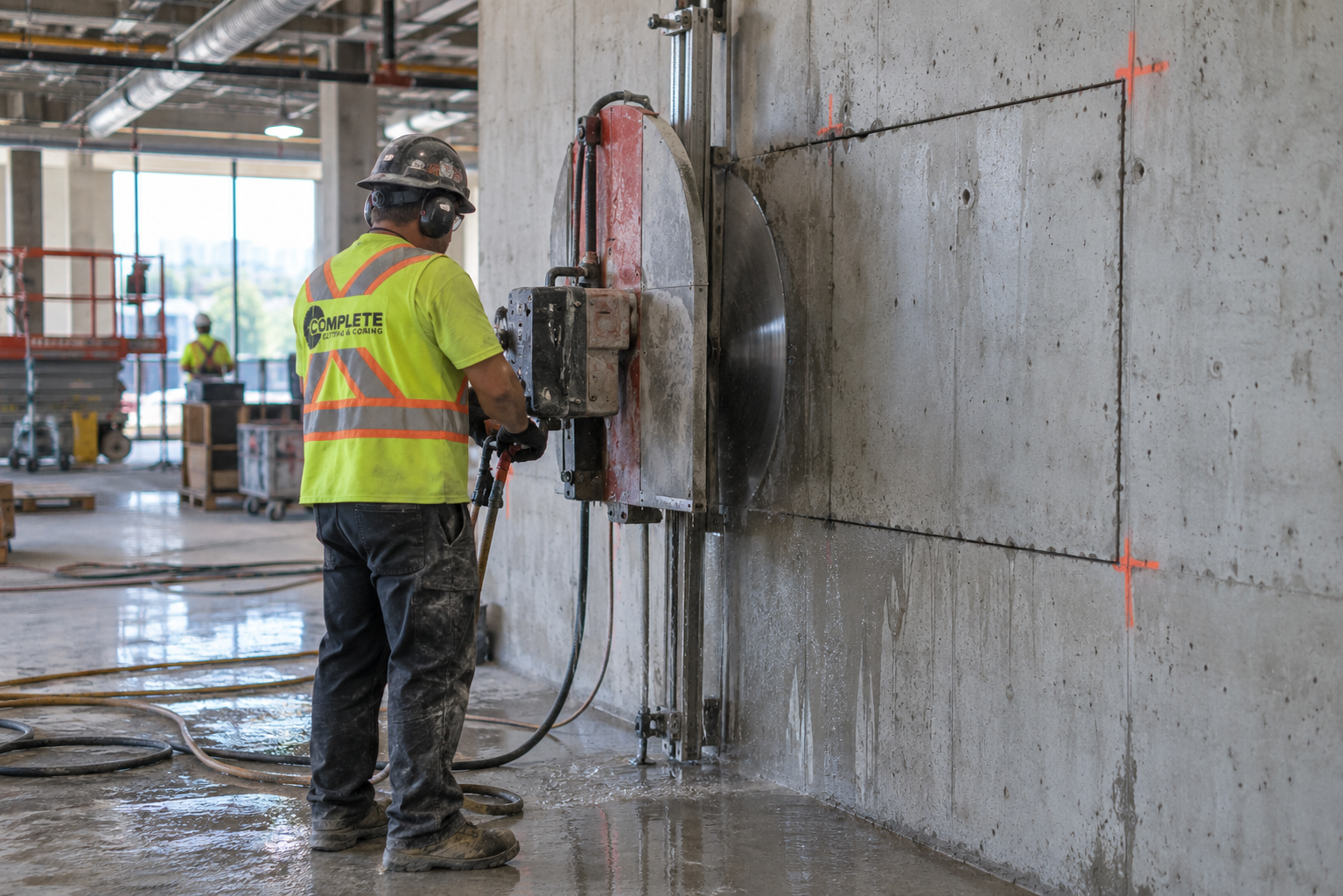
Existing commercial and industrial buildings do not always match the requirements of a new renovation, tenant, production process, or building system. A project may require a new access point, equipment opening, mechanical upgrade, or layout change through an existing concrete wall.
For contractors and facility teams planning these modifications, the required opening and site conditions help determine the appropriate cutting method. London concrete cutting and coring services can support these projects when existing concrete needs to be modified as part of a coordinated commercial renovation.
When an Existing Concrete Wall Becomes a Project Constraint
Concrete walls are built around the original layout and intended use of a facility. When the building changes, those existing walls can become constraints that need to be addressed before renovation work, equipment installation, or building-service upgrades can move forward.
A commercial renovation may require a new doorway between spaces, a larger access opening for equipment, or modifications to accommodate mechanical systems. Industrial facilities can face similar requirements when production areas are reconfigured or equipment and services are updated.
Existing reinforced concrete adds another consideration. Modifying the wall is not simply a matter of removing material from an inconvenient location. The required opening, its dimensions, its position, and the conditions around the work area all influence how the concrete cutting scope should be planned.
The cutting contractor works from the established project requirements. Any structural assessment, approval, or specification related to modifying the wall remains the responsibility of the appropriate project professionals.
When Wall Sawing Is the Right Cutting Method
Wall sawing is suited to projects that require controlled, straight cuts through vertical concrete surfaces. It can be used where a commercial modification requires defined cut lines and controlled removal of a section of concrete.
The decision should begin with the opening the project needs rather than with the equipment used to produce it. Contractors should consider the required dimensions, wall orientation, concrete conditions, surrounding work area, and how the removed concrete will be managed.
Concrete wall sawing can be appropriate for defined openings through concrete and reinforced concrete walls during commercial renovations and industrial modifications. The method allows the cutting scope to follow an established layout rather than relying on less controlled removal.
This distinction matters when the finished opening must fit into a larger construction plan. Door openings, equipment access points, and other planned modifications need to correspond with the requirements established by the project team.
Wall Openings for Commercial Renovations and Building Upgrades
A building can remain useful while its original configuration no longer supports current operations. Renovations often involve adapting an existing structure rather than replacing it, which can make new concrete openings an important part of the project.
For example, a planned modification may require improved access between areas, space to move or install equipment, changes to a mechanical room, or a revised interior layout. Industrial upgrades can also create requirements for openings that were not part of the original building configuration.
Wall sawing can become part of solving these access and layout problems when the required modification involves a defined opening through an existing concrete wall. The cutting work should fit into the overall renovation sequence rather than being treated as an isolated task.
That means considering what happens before and after the opening is created. Other trades may need access to the area, removed concrete must be managed, and subsequent construction may depend on the opening being ready at the correct stage of the project.
Wall Sawing vs Core Drilling for Building Services
Not every opening through concrete requires wall sawing. Commercial projects often involve different types of penetrations, and the required shape and purpose of each opening help determine the appropriate cutting method.
Core drilling is generally used for individual circular penetrations for pipes, conduit, mechanical services, and similar requirements. These penetrations serve a different purpose from larger openings intended for access, equipment, or significant building modifications.
Wall sawing is used for larger or defined openings that require controlled linear cuts through concrete walls. Rather than viewing the two services as competing methods, contractors can consider the specific opening required at each location.
Some commercial modifications may involve both. A renovation could include defined wall openings as well as separate penetrations for new building services, with each cutting requirement coordinated as part of the broader project.
Planning the Opening Before Concrete Cutting Begins
Effective planning starts with a clearly established opening location and scope. The cutting crew should know the required dimensions, layout, and intended purpose of the opening before concrete cutting begins.
Project teams should also consider existing building services and access to the work area. These factors can affect how the cutting work is incorporated into the construction sequence and how the area is prepared for the work.
Concrete removal is another practical consideration. A planned wall opening results in material that must be handled as part of the work, so removal planning should be considered alongside the cutting itself.
Coordination with other trades can be especially important on renovation projects where several activities are taking place in the same area. Establishing the cutting requirements early can help the project team determine when the work needs to occur and what must be ready beforehand.
Any structural requirements remain the responsibility of the appropriate project professionals. The concrete cutting scope should follow the approved project information and clearly established opening location.
Coordinating Wall Sawing in Active Commercial Buildings
Commercial renovations do not always take place in empty buildings. Cutting work may need to be coordinated within occupied facilities, operational areas, tenant spaces, or sites where other construction trades are working nearby.
These conditions make communication and sequencing important. Access to the work area may be restricted, surrounding spaces may need to remain available, and other trades may depend on the opening before they can complete their own work.
Preparing the area also involves considering how removed concrete will be managed and how the work fits with activities around it. The goal is controlled execution that supports the construction plan while avoiding unnecessary disruption to adjacent operations.
Clear communication between construction managers, facility representatives, contractors, and the concrete cutting crew helps keep responsibilities and timing understood. For multi-trade projects, this coordination can be as important as selecting the appropriate cutting method.
Planning Commercial Wall Sawing in London
Commercial renovations and industrial facility modifications in London can require new concrete openings as buildings are adapted for changing layouts, equipment, access requirements, and building services. Identifying these cutting requirements during project planning gives teams an opportunity to coordinate them with the broader construction schedule.
Complete Cutting & Coring supports concrete opening requirements within commercial and industrial modification projects. Working with commercial and industrial concrete cutting contractors allows the wall sawing scope to be coordinated around established openings, work-area requirements, other trades, and project sequencing.
For a commercial renovation or industrial modification requiring wall sawing in London, provide the project details and established cutting requirements so the scope can be reviewed.