
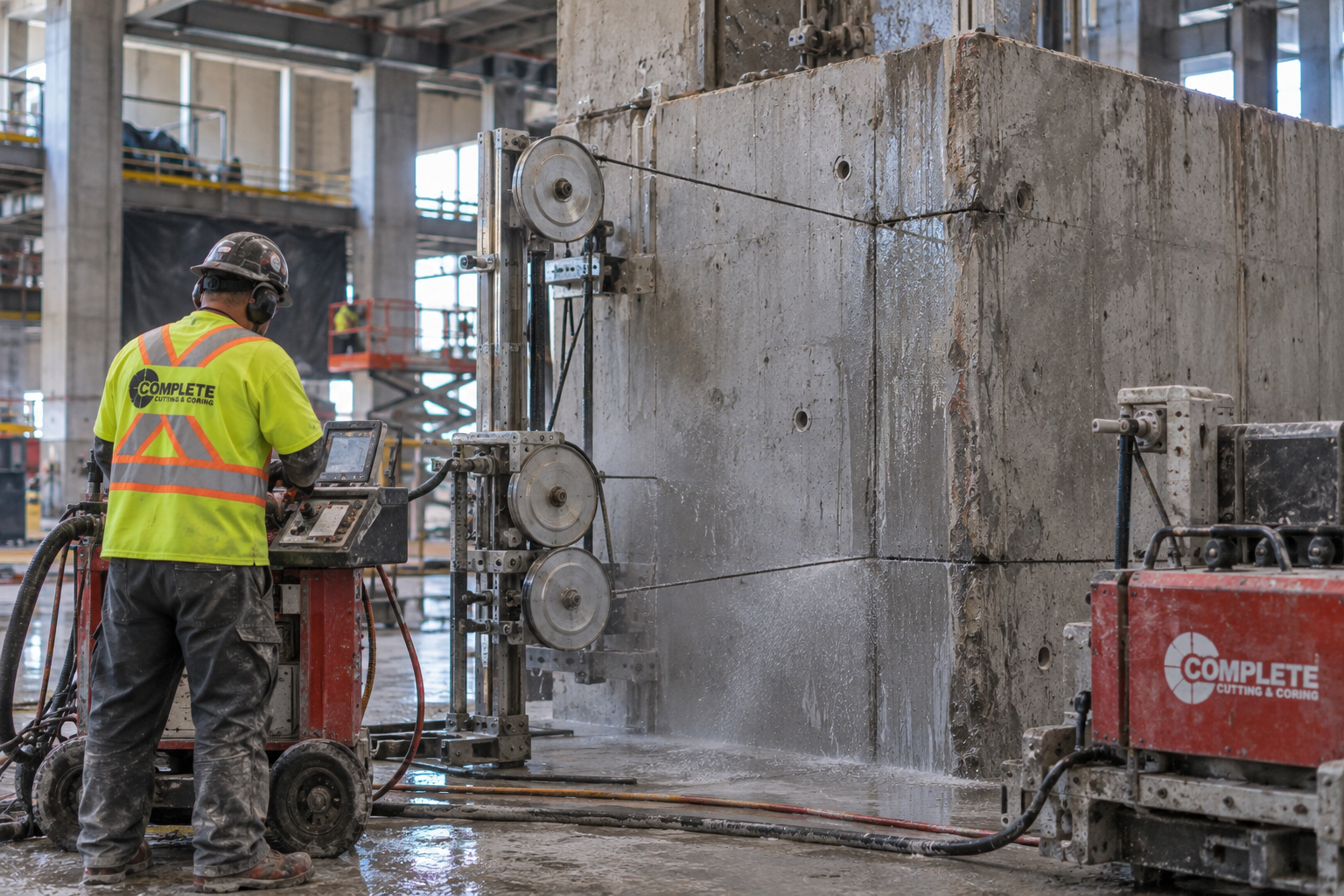
Some commercial and industrial concrete modifications exceed the practical cutting conditions associated with conventional slab or wall cutting. Large concrete sections, heavy reinforcement, restricted access, or unusual configurations can make the cutting scope more complex.
At that point, the question is not simply how to cut the concrete. Project teams need to determine how a controlled cut can be completed within the actual access, sequencing, and removal requirements of the job.
For substantial concrete removal, understanding these conditions early can help contractors establish a more complete cutting scope and coordinate it with the other work taking place on the project.
What Makes a Concrete Cutting Project Too Large or Complex for Conventional Methods?
Concrete cutting requirements vary considerably between projects. A typical slab cut or defined wall opening may be addressed using conventional cutting methods, while substantial structural components or large removal scopes can create different constraints.
Concrete dimensions are one consideration, but they are not the only factor. Heavy reinforcement, restricted cutting access, unusual shapes or configurations, and the size of the section being removed can all influence the cutting approach.
The surrounding work area matters as well. Commercial and industrial projects may involve existing equipment, active operations, other trades, or limited access around the concrete. A method that works for an accessible section may not be practical when the same type of concrete is located within a restricted work area.
Removal requirements can add another layer to the decision. The project team must consider not only where cuts are required, but also how the separated concrete fits into the overall removal plan.
There is no single concrete thickness or reinforcement level that automatically determines the appropriate cutting method. The complete set of project conditions needs to be reviewed together.
Where Wire Sawing Fits
Wire sawing can be used for substantial concrete sections and large-scale controlled cuts where conventional saw configurations may be impractical. This can include reinforced concrete and commercial or industrial modifications involving difficult cutting conditions.
Wire sawing should not be viewed simply as a more powerful version of another concrete cutting method. Its application is connected to the size and configuration of the concrete, reinforcement, access conditions, required cut geometry, and removal requirements.
This distinction is important for commercial project teams. The objective is not to select the most substantial cutting method available. It is to identify a method suited to the actual conditions of the required cut.
For contractors, the practical question is whether the planned cutting approach can address the required concrete section while fitting within the site’s access and project constraints.
The Project Conditions That Can Point Toward Wire Sawing
Several factors can lead a project team to consider commercial concrete wire sawing. These factors should be evaluated as part of the complete cutting and removal scope rather than individually.
Concrete dimensions are an important starting point. Substantial sections can create cutting conditions that differ from typical slab cuts or defined wall openings. Reinforcement can add another consideration when a project involves large reinforced concrete components.
Access to the cutting area also affects planning. A project may involve concrete in a location where conventional equipment positioning is difficult or where the geometry of the required cut creates additional constraints.
The required cut geometry should be considered alongside these physical conditions. Unusual configurations can change how the project team approaches the cutting scope, particularly when the section needs to be separated in a controlled manner.
The size of the section being removed and what happens after separation also matter. Handling requirements, surrounding operations, access routes, and the planned removal sequence can influence how the cutting work fits into the larger project.
Project sequencing becomes particularly important when demolition crews, mechanical contractors, equipment installers, or other trades depend on the concrete removal before their work can proceed. Bringing the concrete cutting contractor into planning early can help establish how the cutting scope relates to these requirements.
Wire Sawing vs Wall Sawing and Floor Sawing
Different concrete cutting methods address different project conditions. The appropriate method depends on the location, orientation, dimensions, configuration, access, and other requirements of the planned cut.
Floor sawing is commonly suited to controlled horizontal cuts through concrete slabs. It can support commercial and industrial work where the cutting requirement is located on an accessible horizontal surface.
Wall sawing is suited to defined vertical openings and wall modifications within the method’s project-specific capabilities. These applications can include planned openings through existing concrete walls.
Wire sawing becomes relevant when concrete size, configuration, reinforcement, or access makes conventional cutting approaches impractical for the particular scope. It is not automatically a better method. Each approach has a different role depending on the project’s cutting requirements.
This is why method selection should follow the scope rather than precede it. Establishing what needs to be cut, where it is located, and how the separated material will be managed provides a more useful basis for planning.
Cutting the Concrete Is Only Part of the Removal Plan
Creating the cut is only one stage of substantial commercial or industrial concrete removal. Project teams also need to consider what will happen once the concrete section has been separated.
The size and weight of cut sections can affect the broader removal plan. Work-area access, handling considerations, surrounding equipment, other contractors, and the removal sequence all need to be addressed by the appropriate project teams.
These considerations become particularly important when large concrete removal takes place within an existing facility. The cutting scope needs to fit within the established plan for managing the separated material and completing subsequent work.
For example, access that is sufficient for the cutting operation still needs to be considered in relation to the overall removal scope. Other contractors may also have responsibilities connected to handling or subsequent work in the area.
A successful cutting plan therefore considers what happens after the concrete is separated, not only how the cut itself will be made. Structural, lifting, rigging, and engineering requirements remain with the appropriate qualified project professionals.
Wire Sawing in Active Commercial & Industrial Facilities
Complex concrete modifications can arise across a range of commercial and industrial environments. Industrial facilities, manufacturing environments, commercial infrastructure, and other operational properties may require existing concrete to be modified as equipment, layouts, and facility requirements change.
These projects can introduce conditions that are not present on an open construction site. Restricted-access areas, existing equipment, ongoing operations, and multi-trade construction activity can all influence how industrial concrete cutting is planned.
Facility modifications and equipment upgrades can also place concrete cutting within a larger sequence of work. The required section may need to be removed before new equipment can be moved into place or before another contractor can continue with a planned modification.
The objective is to establish a cutting scope that accounts for the actual environment. This includes understanding where the concrete is located, how the cutting area can be accessed, and how the work relates to surrounding operations and other project activities.
Planning Complex Concrete Cutting With the Project Team
Complex concrete cutting benefits from early coordination. Before work begins, the project team should establish the required cutting scope, site conditions, access requirements, sequencing, and relevant removal considerations.
Other trades may also need to be incorporated into the plan. Concrete removal can affect demolition work, equipment installation, building modifications, and other activities that depend on the cutting being completed at a particular stage.
Working with commercial and industrial concrete cutting contractors during project planning allows cutting requirements and project-specific limitations to be discussed before work reaches the execution stage.
Clear information about the concrete section, required modification, work area, access, and removal requirements gives the cutting contractor useful context for reviewing the scope. It also helps keep the cutting work connected to the broader construction or facility modification plan.
When to Discuss Wire Sawing With Complete Cutting & Coring
Contractors and project managers do not need to determine the concrete cutting method alone. When a commercial or industrial project involves unusually large concrete sections, substantial reinforcement, difficult access, complex configurations, or significant removal requirements, the cutting conditions can be reviewed during project planning.
Complete Cutting & Coring can review the defined cutting requirements in relation to the site conditions and commercial or industrial scope. Structural decisions and project-specific engineering, lifting, and rigging requirements remain with the appropriate qualified professionals.
For a project involving substantial or difficult concrete removal in Southern Ontario, Request an Estimate or call (519) 465-4107 to discuss the cutting requirements.